DECCA
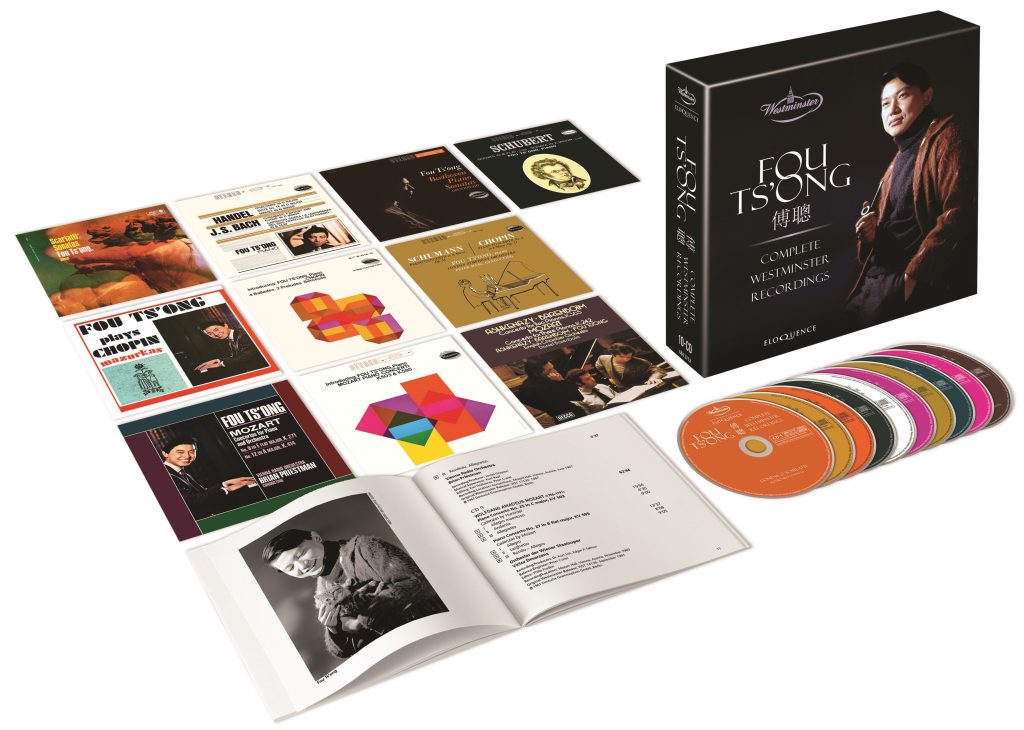
Fou Ts'ong: Complete Westminster Recordings (10 CDs)
Fou Ts'ong: Complete Westminster Recordings (10 CDs)
FORMAT:
Couldn't load pickup availability

The Westminster label legacy of a master Chopin interpreter, issued complete for the first time in an 'original covers' box of new remasterings. Almost half a century before Lang Lang, the pianist Fou Ts'ong took Europe and then the US by storm. With his third-prize finish at the 1955 International Chopin Competition in Warsaw, listeners and critics alike were astonished to encounter a mature and seemingly instinctive feel for the uniquely Polish rhythms and passing harmonies of Chopin's music, under the fingers of a 21-year-old from Shanghai. Having undertaken further studies in Poland, Fou Ts'ong left his family behind and settled in London to escape the looming shadow of Chinese authoritarianism. He entered into a relationship with the Westminster label, for whom he would record nine albums between 1960 and 1967, all newly remastered and gathered together for the first time in the present collection. They encompass a good range of his repertoire predilections, as well as the scope of his youthful artist maturity. He is also joined by Daniel Barenboim and Vladimir Ashkenazy for a joyous traversal of Mozart's concertos with two and three pianos in a 1972 Decca recording. His Westminster collection of 12 Scarlatti sonatas was praised at the time for it's crisp, modern approach and vividly naturalistic touches. An album of Bach and Handel similarly reveals the intelligence, taste and inherent musicality which Fou Ts'ong brought to this repertoire on the modern concert grand. Several more Westminster albums demonstrate Fou's affinity for Mozart: not so surprising, given that he imprinted on his father's record collection with it's 78s of Artur Schnabel and Wanda Landowska. The pianist may have forsaken his homeland for good, but his musicianship encompassed both European and Chinese aesthetic ideals. He praised Chinese poetry for it's strength of feeling without excess: 'It has to remain dignified, spiritual and always beautiful'. These qualities also illuminate the albums of Beethoven and Schubert sonatas collected here. 'The Chinese are also very concerned with detail,' he said: 'Every part must be right, but on the other side the expression must be spontaneous and true,' and an appreciation for this fine balance made him associated above all with the music of Chopin. Although he recorded Chopin's Mazurkas at different times throughout his career, the group of eighteen issued by Westminster arguably represents his interpretations at their freshest and most creative. The Four Ballades likewise established a benchmark of sensitivity among a younger generation of Chopin pianists. The Second Concerto of Chopin, and it's original coupling of the Schumann Concerto appear in stereo on CD for the first time. The new collection makes a timely tribute to the artistry of a pianist who died of Covid-19 late last year.
“There is a great deal to enjoy on this record, and it is immensely refreshing to come across a Chopin pianist who thinks too much, if anything … I very much hope we shall be hearing more of Fou’s Chopin.” Gramophone, July 1961
“His technical equipment is marvellous, and his interpretive abilities are … ideally suited to the music here.” Stereo Review, January 1962 (Chopin: Ballades)
“Fou Ts’ong makes a notable impression with his clean and well-proportioned renditions of these two masterful concertos … recorded sound that is completely natural both in balance and warmth of tone.” Stereo Review, January 1962 (Mozart: Piano Concertos KV 503 & 595)
“The performances strike me as being within striking distance of ideal … he is a remarkably musical pianist.” Gramophone, April 1962 (Mozart: Piano Concertos KV 503 & 595)
“Fou Ts’ong is a brilliant technician and an inspired keyboard poet … His interpretations are as poetic and romantic as anyone’s, with singing melodic lines and considerable rhythmic license and tonal painting, but unlike the performances one hears so often these build cohesively… I would say that this is quite the best recorded edition of the Ballades.” High Fidelity, February 1962 (Chopin: Ballades, Préludes, Berceuse)
“The feeling for Beethoven’s musical vocabulary is spontaneous, the approach is wholly sympathetic, and all the difficult passages are carried by an unwavering sense of the style.” High Fidelity, June 1962 (Beethoven)
“A beautifully balanced, exquisitely shaped reading of subtle charm. It is now my favourite modern recording.” Stereo Review, June 1964 (Schumann: Piano Concerto)
“Fou Ts’ong’s deeply subjective yet rather severe interpretative outlook and his pointillistic fingerwork find an ideal outlet in this literature. While there is a ringing clarity and sharp linearity in a tonal approach at times suggestive of the harpsichord, Fou fully utilizes the coloristic potentialities of which the piano is capable.” High Fidelity, July 1964 (Bach)
“It is futile to attempt any explanation of the psychic alchemy by which a Chinese pianist has evolved such masterly readings of the most purely Polish and personal of all Chopin’s works. We can only accept such a gift with joy and a sense at fulfilment, as well as with the hope that this artist will one day commit the entire series of mazurkas to discs.” High Fidelity, February 1965 (Chopin: Mazurkas)
“Fou Ts’ong achieves a miraculous blend of the folk-dance, salon, and lyrical aspects of these works … His handling of the trills in Op. 68 No. 4, the last of Chopin’s completed works, makes of this tragic piece a quite shattering experience. The recorded sound is excellent all the way: this is an outstanding disc.” Stereo Review, February 1965 (Chopin: Mazurkas)
“I am very impressed with the vital and sensitive way Fou plays, and delighted that he should join the ranks of true Handelians … He is a pianist with unusually communicative fingers, and a fine control of line, and he is also admirable in Bach.” Gramophone, June 1965 (Bach/Handel)
“[Mozart] finds Fou Ts’ong on good terms with the music, probing deeply into the sadly expressive Andantino with as much intensity as taste. The outer movements tend towards youthful élan” High Fidelity, February 1968 (Mozart: Piano Concertos KV 271 & 414)

CD 1
DOMENICO SCARLATTI (1685–1757)
Keyboard Sonatas
Sonata in C major, Kk 132 (L.457)
Sonata in C minor, Kk 73 (L.217)
Sonata in F major, Kk 82 (L.82)
Sonata in B minor, Kk 27 (L.449)
Sonata in E major, Kk 380 (L.23)
Sonata in F major, Kk 483 (L.483)
Sonata in G major, Kk 124 (L.482)
Sonata in F major, Kk 151 (L.238)
Sonata in F major, Kk 256 (L.256)
Sonata in E major, Kk 206 (L.257)
Sonata in C minor, Kk 11 (L.352)
Sonata in C major, Kk 255 (L.255)
CD 2
GEORGE FRIDERIC HANDEL (1685–1759)
Chaconne in G major, HWV 435
Suite No. 14 in G major, HWV 441
Minuet in G minor, HWV 434/4
JOHANN SEBASTIAN BACH (1685–1750)
Chromatic Fantasia and Fugue in D minor, BWV 903
Capriccio on the departure of a beloved brother, in B flat major, BWV 992
CD 3
LUDWIG VAN BEETHOVEN (1770–1827)
Piano Sonata No. 30 in E major, Op. 109
Piano Sonata No. 31 in A flat major, Op. 110
CD 4
FRANZ SCHUBERT (1797–1828)
Piano Sonata No. 14 in A minor, D.784
Piano Sonata No. 21 in B flat major, D.960
CD 5
FRÉDÉRIC CHOPIN (1810–1849)
Mazurkas
Mazurka in E major, Op. 6 No. 3
Mazurka in A minor, Op. 7 No. 2
Mazurka in E minor, Op. 17 No. 2
Mazurka in A minor, Op. 17 No. 4
Mazurka in G minor, Op. 24 No. 1
Mazurka in C major, Op. 24 No. 2
Mazurka in B flat minor, Op. 24 No. 4
Mazurka in C minor, Op. 30 No. 1
Mazurka in B minor, Op. 30 No. 2
Mazurka in B minor, Op. 33 No. 4
Mazurka in E minor, Op. 41 No. 2
Mazurka in C sharp minor, Op. 50 No. 3
Mazurka in C minor, Op. 56 No. 3
Mazurka in A minor, Op. 59 No. 1
Mazurka in G minor, Op. 67 No. 2
Mazurka in A minor, Op. 67 No. 4
Mazurka in A minor, Op. 68 No. 2
Mazurka in F minor, Op. 68 No. 4
CD 6
FRÉDÉRIC CHOPIN (1810–1849)
Ballades Nos. 1–4
Prélude in A flat major, Op. posth.
Prélude in C sharp minor, Op. 45
Berceuse in D flat major, Op. 57
CD 7
ROBERT SCHUMANN (1810–1856)
Piano Concerto in A minor, Op. 54
FRÉDÉRIC CHOPIN (1810–1849)
Piano Concerto No. 2 in F minor, Op. 21
London Symphony Orchestra / Peter Maag
CD 8
WOLFGANG AMADEUS MOZART (1756–1791)
Piano Concerto No. 9 in E flat major, KV 271 ‘Jeunehomme’
Piano Concerto No. 12 in A major, KV 414
Vienna Radio Orchestra / Brian Priestman
CD 9
WOLFGANG AMADEUS MOZART (1756–1791)
Piano Concerto No. 25 in C major, KV 503
Piano Concerto No. 27 in B flat major, KV 595
Orchester der Wiener Staatsoper / Victor Desarzens
CD 10
WOLFGANG AMADEUS MOZART (1756–1791)
Concerto for Three Pianos and Orchestra (No. 7) in F major, KV 242 ‘Lodron’
Concerto for Two Pianos and Orchestra (No. 10) in E flat major, KV 365
Vladimir Ashkenazy, Daniel Barenboim, Fou Ts’ong; English Chamber Orchestra
FOU TS’ONG, piano
STEREO RECORDINGS